Pivot doors: how they work and how they compare
A pivot door is the most architectural of the steel-look doors, but it is not always the obvious choice for every door opening. To decide what suits your space, it helps to understand how a pivot door actually works and how it differs from a sliding or hinged door. We walk you through the mechanism and the practical differences, so you can make an informed choice.
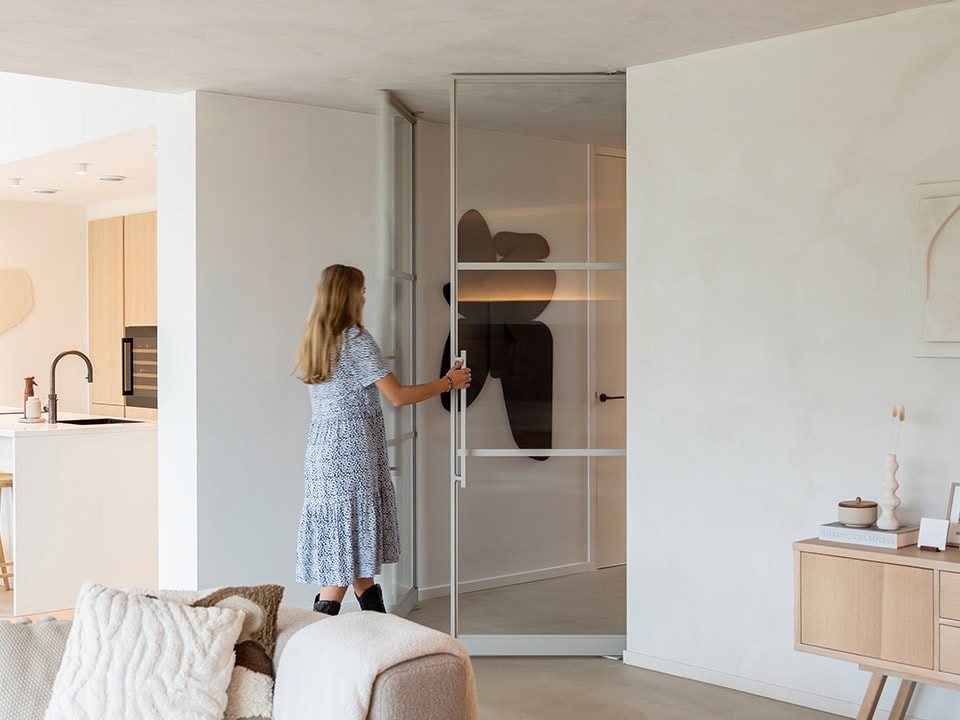
How a pivot door works
A pivot door rotates on a vertical axis rather than swinging from hinges on one side. The pivot points sit hidden in the top and bottom of the slim profile, and the weight of the door rests on the floor point rather than on a side frame. That is what gives a pivot door two of its defining qualities: it needs no surrounding frame, and even a large panel opens with a light, fluid movement.
Because there is no frame, the door sits directly in a neatly finished opening and appears to float. The pivot also lets the door swing in both directions, so you can push it away from you either way. When it opens, part of the panel turns into the room, which is why a pivot door needs a little clearance on the swing side.
How a pivot door differs from sliding and hinged doors
What sets a pivot door apart is most visible when you place it next to the other steel-look options. A hinged door hangs from one side and leans on a frame for support, which limits how large and how heavy the panel can be.
A sliding door avoids that by gliding along a ceiling rail, but it always needs a stretch of wall to slide against. A pivot door does neither: it carries its weight on the floor and ceiling points, so it needs no frame and no wall to rest against, and it will not sag over time.
That freedom is exactly why a pivot door makes such a statement. Where a hinged door stays modest in size and a sliding door follows the wall, a pivot door stands on its own in the opening and turns in both directions.
Do consider the space a pivot door needs. Unlike a sliding door, a pivot door needs room to swing into on both sides. So if your opening is wide or tall and you have the floor space, a pivot door rewards you with an effect neither of the others can match. In a narrow hallway, a sliding door or an offset-pivot layout is the more practical route.
When is a pivot door the right choice?
A pivot door comes into its own in spacious entrance halls, as a transition between main living areas, or in tall openings where a standard hinged door would look out of proportion. The generous glass surfaces draw daylight from one room into the next and keeps the connection between spaces open and airy.
In narrower hallways or smaller rooms, a sliding door or an offset-pivot layout is often more practical, simply because there is less floor space to swing into.
Materials, glass and finish
Every Emezzi pivot door is made from lightweight aluminium, around 15% lighter than steel, with a slim 30-millimetre profile that is identical on both sides. The doors are powder-coated in your chosen RAL colour and come standard with 6 millimetre safety glass. The lighter glass keeps the panel easy to turn on its pivot points, which is part of why a pivot door feels so effortless to open compared with a heavier framed door.
Design your pivot door
Do you want to see the exact options, sizes and pivot positions in detail? You will find them, along with the all-in price, in our configurator. Are you still unsure which door type fits your door opening best? Don’t hesitate to contact us.