Sliding doors explained
A sliding door is the space-saver among the steel-look doors. Instead of swinging open into a room, it glides sideways along a rail, so you keep every centimetre of floor free. That makes it a practical choice in tight spaces, and a stylish one in open-plan interiors where you want to divide a room without losing light.
Because our sliding doors are made from lightweight aluminium rather than steel, they run smoothly and need very little from your home to install.
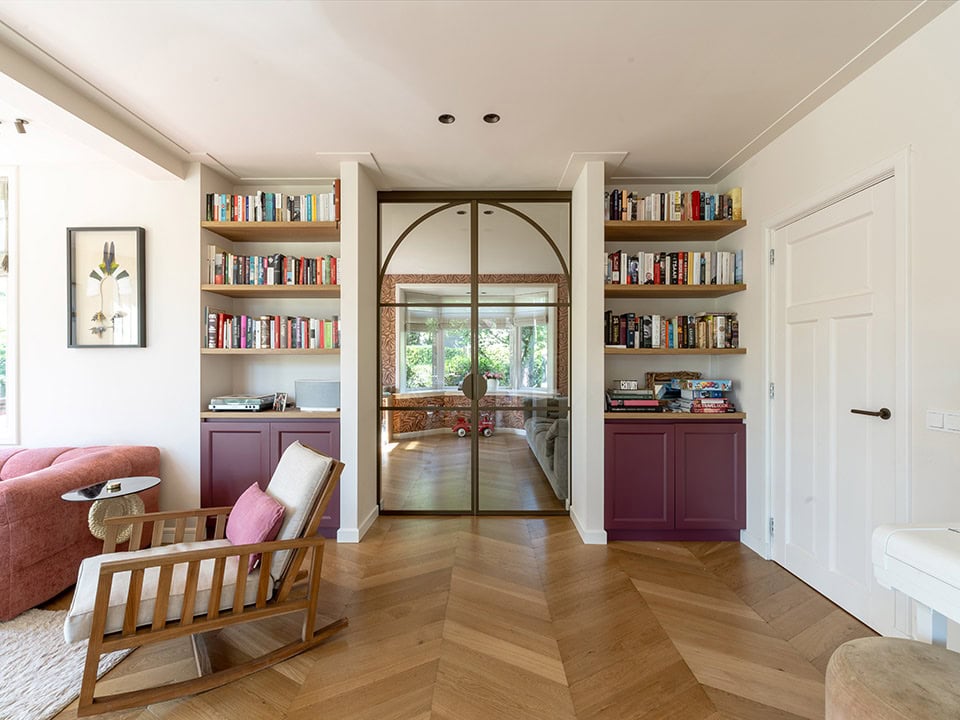
How a sliding door works
A sliding door hangs from an aluminium rail mounted to the ceiling. The door panel slides along this rail, moving sideways in front of the wall instead of swinging into the room. The rail carries the full weight of the door, so nothing rests on the floor. This prevents a lot of damage.
We drill four centimetres into the ceiling to fix the rail, which is why the ceiling needs to be solid. Concrete and wood both offer more than enough strength. Because there is no drilling into the floor needed, a sliding door is a good option in rooms with underfloor heating. The heating pipes are never at risk. An optional soft-close mechanism slows the door at the end of its travel, so it closes gently and quietly every time.
Where does a sliding door work best?
A sliding door comes into its own wherever a swinging door would be in the way. A few typical situations:
- Tight spaces, where there is no room for a door to swing open
- Open-plan interiors, where you want to separate a kitchen, living room or home office without building a wall
- Rooms with underfloor heating, since the rail is fixed to the ceiling and not the floor
- Spots where you want a large glass surface that lets daylight flow from one room to the next
Because the door slides along the wall, you do need a free section of wall next to the opening, where the door slides when it opens. That is the main thing to check before you choose this door type.
Sliding doors compared to other steel-look doors
A sliding door stands out from the other steel-look options in one clear way: it does not need any floor space to open. It slides sideways along the wall, so nothing swings into the room.
The alternatives for sliding doors work differently. A pivot door makes a stronger visual statement, but needs room to swing into on both sides. A hinged door opens like a classic door and comes with its own slim frame, but also needs clearance to open.
A sliding door asks for neither, only a free stretch of wall to slide along. So if space is tight, the sliding door is usually the most practical choice.
Materials, glass and finish
Every Emezzi sliding door is made to measure from lightweight aluminium, around 15 percent lighter than steel, with a slim 30 millimetre profile that looks identical on both sides. The doors are powder-coated in the RAL colour of your choice and come standard with 6 millimetre safety glass, which is always laminated.
Because the profiles are slim, a sliding door brings in plenty of daylight and keeps a clean, modern line. Aluminium does not rust, so the door stays looking its best. A quick clean is usually all it takes.
Design your own sliding door
Are you curious what a sliding door would look like in your space? Design your own door in our configurator, choose your colour, glass and layout, and see an all-in price in minutes. Do you still have questions about whether a sliding door fits your room? Don’t hesitate to contact us.