Hinged doors explained
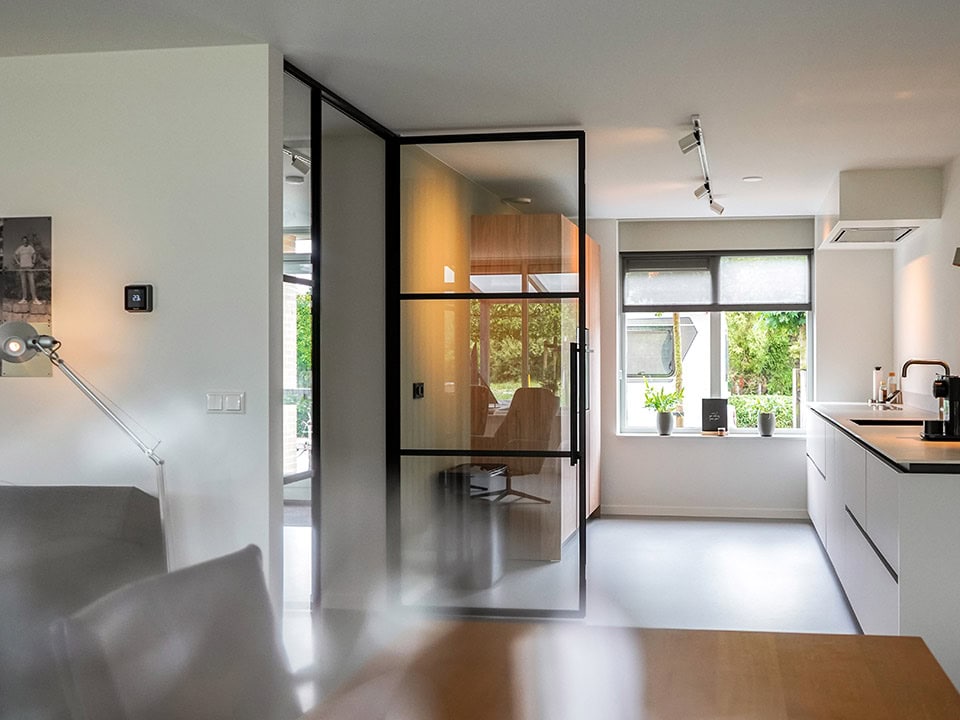
A hinged door is the most familiar of the steel-look doors. It opens the way most doors do, swinging on hinges from one side, which makes it a natural choice in many homes.
What sets the Emezzi version apart is the slim aluminium frame and the steel-look profiles, which give a classic door type a modern line. But how does a hinged door work, which frame is used, and where does a hinged door fit best? By answering this and other questions, you can see whether a hinged door suits your space.
How a hinged door works
A hinged door hangs from hinges on one side and swings open into the room. Unlike a pivot door or a sliding door, it comes with its own slim aluminium frame, which is fixed in the door opening. This frame also carries the door. The hinges are slightly visible and finished in the same colour as the door, so they blend into the profile rather than it stands out.
A hinged door gives you a choice that the other steel-look doors do not: you decide which way it opens. You set the swing direction and the side the hinges sit on, so the door fits the way you move through the room and opens against the right wall. An Emezzi dealer goes through the options with you, so the door suits both the space and how you use it.
The frame: new or existing
A hinged door always works with a frame, and here you have two options. The standard choice is our own slim aluminium frame, made to measure and fitted into the opening. It matches the door, with the same finish on both sides and no visible welding seams.
Do you already have a frame in place? Then there is a second option. We can fit the door into an existing frame, as long as it is a square wooden frame with a depth of 49 millimetres. This can save work during a renovation, since the existing frame can stay. During the measurement visit, an Emezzi dealer checks whether your existing frame is suitable, so you know in advance which route fits your situation.
Single or double doors
A hinged door can be made as a single door, or as a double door for a wider opening. A double door meets in the middle and opens from both sides, which works well for a broad passage between two rooms, such as between a living room and a kitchen. In that way, you can match the door to the width of your opening, from a standard doorway to a wide connection between spaces.
A thicker glass for everyday use
A hinged door from Emezzi comes standard with 10 millimetre glass, thicker than the 6 millimetre glass used in our sliding doors and pivot doors. That extra thickness suits a door that opens and closes against a frame day in, day out. This makes a hinged door well suited to spots where you want a solid, reassuring close, such as a hallway or an entrance. The glass is always laminated, and if you prefer 6 millimetre glass, that is possible too.
A light, low-maintenance door
Every Emezzi hinged door is made to measure from aluminium, with a slim 30 millimetre profile that looks identical on both sides. Aluminium is lighter than steel, around 15 percent, so the door swings easily on its hinges and stays comfortable to use every day. It does not rust, so it only needs an occasional clean.
You choose the door in the RAL colour that suits your interior, with the glass and layout made to your opening. The standard finish is black, but almost any RAL colour is possible.
Design your hinged door
Would you like to see what a hinged door would look like in your home? Design your own door in our configurator, where you choose the colour, glass and layout and see an all-in price in minutes. Do you still have questions about which door type fits your opening? Don’t hesitate to contact us.